Shared context and human review for AI coding agents
Agents build.
Humans approve.
Today the plan lives in the agent's context window — it dies at compaction,
and your first look at the work is a 500-line diff. Taskum serves shared project
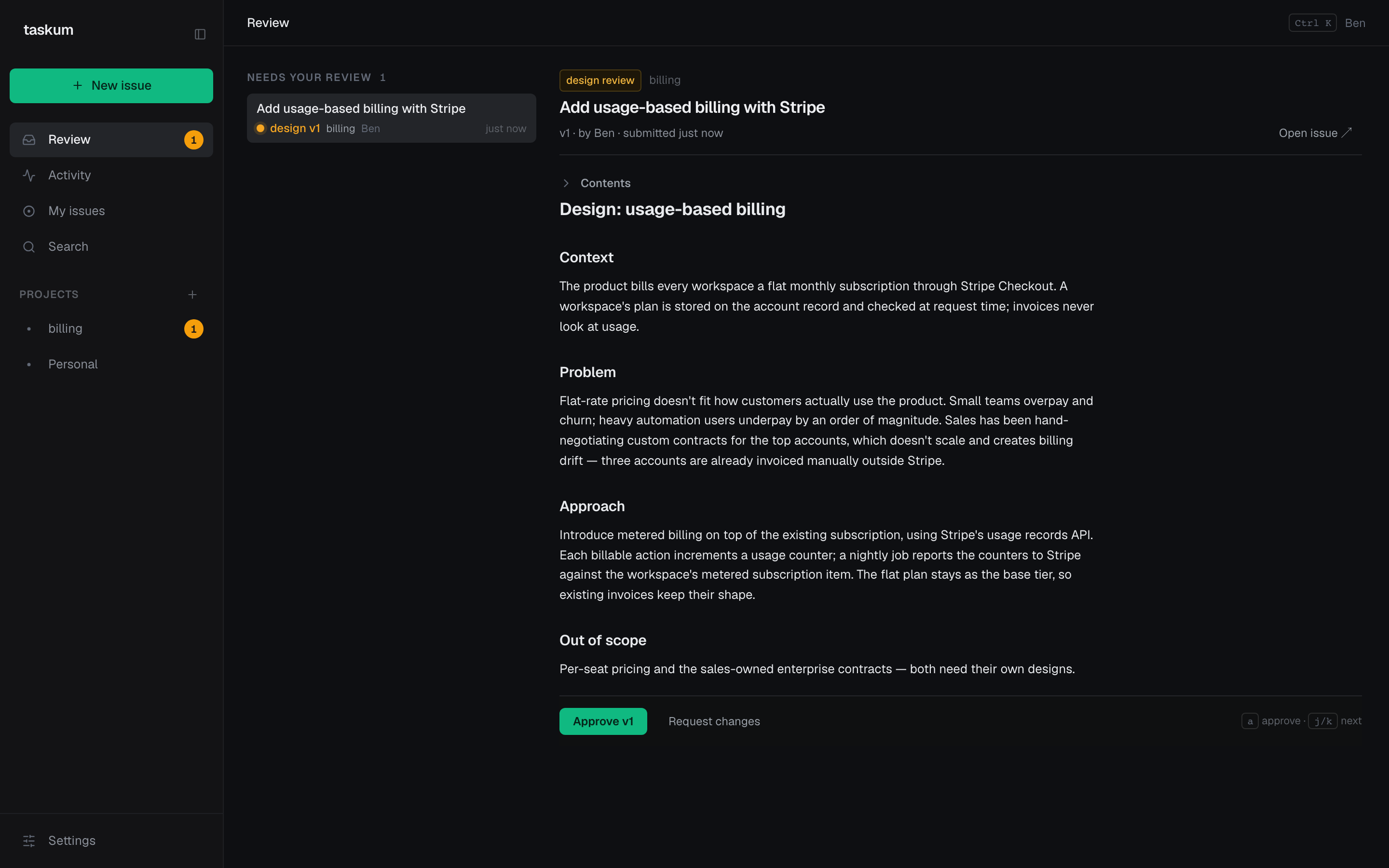
context to every agent over MCP, and the review gates you turn on are enforced by
the server: execution is refused until you approve the plan.
Works with Claude Code, Cursor, Windsurf, and any MCP agent.
taskum.com
Today
prompt → 500 plausible lines
→ skim → merge
→ rewrite, three features later
With Taskum
idea → design doc →
REVIEW → plan
→ REVIEW
→ code → clean PR
the full workflow — lighter ones exist, down to none
The knowledge compounds. Every issue your agent completes makes the next one
better — not because the model improves, but because the project remembers:
the docs stay current and the record accumulates.
Every agent reads the same project context — Claude Code, Cursor, Windsurf,
Cline. A teammate's agent knows what yours decided. A new teammate is productive
on day one.
Connect an agent in a minute.
OAuth in the browser — no API key to mint. Create a project and ask your agent to read the codebase.
Get started Read the docs →